


April 2026, v.1.3
Updated: April 2026
Feedback/Comments :: View Release Notes
- Overview
- Methodology
- Background
- Biochemical Pathway and Nutrition Treatment Rationale
- Nutrition Assessment
- Comparative Standards
- Nutrition Problem Identification
- Nutrition Intervention
- Nutrition Recommendations
- Monitoring and Evaluation
- Resources
- Benefits and Harms of Implementing the Recommendations
- Barriers to Implementation
- Areas for Future Research
- List of Tables
-
Literature Evidence Summary Tables
- T.1 Total Protein and Energy Recommendations for Individuals with Urea Cycle Disorders When Well
- T.2 Monitoring the Nutritional Management of an Individual with UCD when Well
- T.3 Genetic Basis of Urea Cycle Disorders and Related Disorders
- T.4 Nutrition Problem Identification for UCDs
- References
- Contributors
- Appendix A: Recommendation Rating Definitions
- Appendix B: Terms
- Disclaimer
In the mitochondria of liver cells, ammonia combines with carbon dioxide (CO₂) to form carbamoyl phosphate (via the enzyme carbamoyl phosphate synthetase I (CPS1)). This is the first, energy-dependent step of the cycle. N-acetylglutamate is an essential allosteric activator of the enzyme CPS1 . N-acetylglutamate synthase (NAGS)catalyzes the formation of N-acetylglutamate from glutamate and acetyl-CoA in the mitochondria of liver cells.
Carbamoyl phosphate reacts with ornithine to form citrulline (via ornithine transcarbamylase (OTC) ).
Citrulline then moves from the mitochondria into the cytoplasm (via ornithine transporter 1 (ORNT1)) .
In the cytoplasm, citrulline combines with aspartate to form argininosuccinate (via argininosuccinate synthetase (ASS1)).
Argininosuccinate is then split by argininosuccinate lyase(ASL) into arginine and fumarate. Fumarate enters the citric acid cycle, linking amino acid metabolism to energy production.
Finally, arginase (ARG1) cleaves arginine into urea and ornithine. The ornithine re-enters the mitochondria (via ORNT1) to start the cycle again, and urea is released into the bloodstream and excreted by the kidneys.
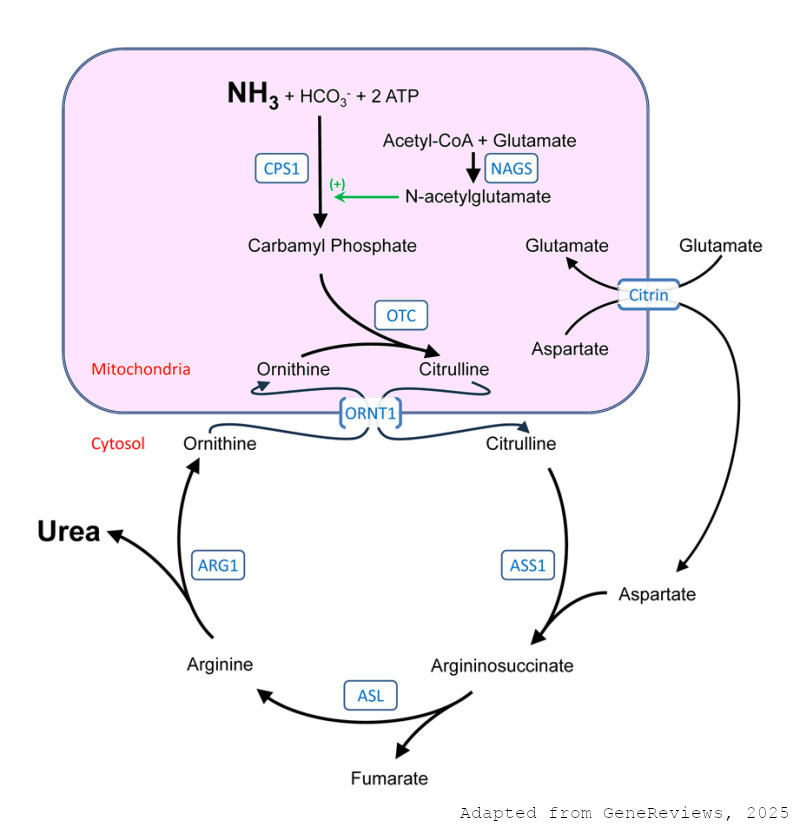
Abbreviations used in the pathway:
ARG1: Arginase
ASL: Argininosuccinate lyase
ASS1: Argininosuccinate synthetase
CPS1: Carbamyl phosphate synthetase I
NAGS: N-Acetylglutamate synthase
ORNT1: Ornithine Transporter 1
OTC: Ornithine transcarbamylase
Urea cycle disorders prevent the body from converting toxic ammonia (from protein breakdown) into urea for excretion. Therefore, treatment focuses on the prevention of ammonia accumulation and facilitating its elimination through alternative routes.
To reduce ammonia production, treatment typically includes restricting dietary protein intake to decrease the nitrogen load while ensuring adequate energy intake. Essential amino acid-based medical foods are commonly provided to support protein synthesis while limiting the nitrogen burden to the urea cycle. Efforts should be made to promote anabolism and reduce catabolic risk.
Alternative pathways for nitrogen excretion include the use of nitrogen scavengers, such as sodium or glycerol phenylbutyrate and sodium benzoate.
Some UCDs lack certain cycle components, and supplementation of downstream, intermediates can maximize any remaining function of the individual's urea cycle function. Arginine becomes a conditionally essential amino acid, and, therefore, requires supplementation in most UCDs (except ARG). L-citrulline supplementation, which is converted to arginine by the urea cycle, is utilized for proximal defects (e.g., CPS, OTC).
During acute crises, rapid ammonia removal may be warranted. Strategies to treat acute crises include temporary removal of protein intake, IV glucose ± lipids to suppress protein catabolism, IV or enteral nitrogen scavengers, IV L-arginine hydrochloride, and hemodialysis.
Liver transplantation may be considered as an available therapeutic option for metabolic stabilization, with implications for long-term health and quality of life.